

WHY YOUR DATA KEEPS LYING TO YOU
Walk into any collegiate athletic department and ask a simple question: how many times has this person, the one sitting in section 114 row 22, interacted with your organization in the last 24 months?
You will get a shrug. Or worse, you will get a confident answer that turns out to be wrong.
The ticketing system knows her as Jennifer Martinez, season ticket holder since 2019. The donor database has her as Jenn Martinez, a Champions Circle member who gave $2,500 last spring. The merchandise platform logged a Jennifer M. who bought three jerseys during bowl season. The email marketing tool has jmartinez@gmail.com opening every newsletter. The parking system knows a J. Martinez with a permit for lot 4.
Five systems. Five versions of Jennifer. Zero unified view.
This is the quiet crisis sitting inside almost every sports organization, and it has a name. In the world of enterprise data, the answer to this problem is called a golden record, and it is managed through a discipline known as Master Data Management, or MDM. These are not new concepts. Fortune 500 companies have been building golden records for two decades. What is new is the urgency, because AI has changed everything about what bad data costs you.
THE INDUSTRY IS WAKING UP TO THE OPPORTUNITY
Ohio State athletic director Ross Bjork put it plainly in a recent conversation with The Athletic about new revenue sources in college sports.
"We're sitting on a ton of data that just hasn't been deployed in a strategic way," Bjork said. "How do we use data to be more strategic about deploying those assets, whether it's premium seating, tickets, merchandise, fundraising, special events? We are not using data effectively to really market and target different groups."
When the AD at a program generating nearly $800 million in revenue over three fiscal years identifies data as the untapped asset, the rest of the industry should take note. Bjork is describing a category-level problem. Every Power 4 athletic department is sitting on the same untapped pile, and the programs that figure out how to deploy it first will have a meaningful head start.
Deploying data strategically starts with knowing who your customers actually are. That is where the golden record comes in.
THE DEFINITION NOBODY GIVES YOU STRAIGHT
A golden record is a single, authoritative, deduplicated profile for a real person or entity, built by intelligently merging information from every system that touches them.
Think of it as the master copy. The one that is right. The one other systems should be looking to for truth rather than claiming to be the source themselves.
Master Data Management is the set of rules, processes, and technology that creates and maintains those golden records over time. MDM is the practice, the golden record is the artifact.
In a collegiate athletic department, a golden record for a fan might combine identifiers like email addresses, phone numbers, mailing addresses, and payment tokens, along with behavioral data like games attended, donations given, merchandise purchased, content consumed, parking used, and concessions bought. Every touchpoint feeds in, every duplicate gets resolved, every conflict gets settled by a rule you define.
The output is one record per person, accurate, current, and trusted by every team that needs it.
HOW WE GOT HERE
To understand why golden records matter so much right now, it helps to understand how athletic departments ended up with the data situation they have.
Most Power 4 programs built their technology stack organically over fifteen or twenty years. Ticketing came first, usually through a major vendor that treated the athletic department as one more account in its broader portfolio. Donor management came next, often through a higher education CRM designed for the university foundation and adapted for athletics. Marketing tools arrived as email providers, then as marketing automation platforms, then as SMS tools, each one sold separately and implemented in isolation.
Somewhere along the way, the team added a merchandise platform, a concessions system, a parking provider, a streaming partner, a rewards program, a mobile app, and a handful of spreadsheets maintained by individual staff members who needed something the official systems did not provide.
Each system was built on the assumption that it was the center of the universe. Each one claimed to be the single source of truth. Each one duplicated the other, and none of them talked to each other in a way that produced reliable answers.
When executives ask for cross-system reporting, someone on the data team exports CSVs, dumps them into Excel, runs VLOOKUPs against email addresses, and hopes the matching is close enough. That report lands in a deck, the meeting happens, decisions get made, and the CSV gets filed away. By the time anyone needs the same information again, the underlying data has moved on, and the whole exercise repeats.
This is not a failure of effort. It is a failure of architecture.
WHY AI MAKES THIS URGENT
For most of the last decade, organizations could get away with messy data because the tools consuming that data were relatively forgiving. A human analyst looking at three versions of Jennifer Martinez could use judgment to figure out they were probably the same person. A marketing manager could scan a donor list, notice the duplicates, and mentally adjust.
AI does not do that.
When you point a large language model at your data and ask it to generate insights, build segments, or recommend actions, it treats every record as truth. If Jennifer exists five times in your data, the AI sees five different people. If her donation history is disconnected from her ticket buying behavior, the AI has no way to know they belong together. If her email preferences contradict across systems, the AI picks one, often the wrong one, and runs with it.
The result is AI output that looks confident, sounds authoritative, and is quietly, systematically wrong.
This is the real cost of bad master data in the AI era. It is not just that your reports are off by a few percent. It is that the intelligent systems you are investing in, the ones your leadership has been promised will unlock millions in incremental revenue, are being fed inputs that guarantee poor outcomes.
Garbage in, garbage out is an old saying. In the AI era, it becomes garbage in, plausible-sounding garbage out, which is considerably more dangerous because it is harder to catch.
WHAT A GOOD GOLDEN RECORD ACTUALLY LOOKS LIKE
A well-built golden record has a few characteristics that distinguish it from a regular database row.
First, it is deduplicated at the identity level. Every Jennifer Martinez, Jenn Martinez, J. Martinez, and jmartinez@gmail.com has been resolved to one record, with confidence scores that indicate how certain the system is about each merge.
The impact of this step alone is often massive. One Equipe customer reduced their CRM storage footprint by 87.5% after deduping records through MDM and golden records, which meant fewer duplicates clogging every downstream workflow, fewer wasted sends, and a database that finally reflected reality.
Second, it is enriched from every source. The golden record does not just contain ticketing data or donor data, it contains both, plus merchandise, email, app usage, parking, and anything else relevant. Each attribute knows where it came from, when it was last updated, and which source to trust when two systems disagree.
Third, it is governed by rules, not guesses. When the ticketing system says Jennifer lives in Austin and the donor database says she lives in Houston, the golden record does not flip a coin. It applies a rule, maybe that the most recent update wins, or that the donor database is authoritative for mailing address, or that a human should review the conflict. Those rules are explicit, documented, and adjustable.
Fourth, it is accessible. A golden record locked inside a data warehouse that only three engineers can query is not delivering its value. The whole point of building it is that anyone in the organization, from the CRO to a junior marketing coordinator, can act on the information inside it.
Fifth, it is current. The golden record updates as new information arrives, reflects recent behavior, and ages gracefully when records go stale.
These characteristics are not aspirational. They are the baseline for master data done well in any industry. Sports organizations deserve the same standard.
WHAT SPORTS ORGANIZATIONS KEEP GETTING WRONG
In conversations with revenue, data, and fundraising leaders across college athletics, a few patterns keep showing up.
The first mistake is treating MDM as a technology purchase rather than a discipline. Buying a platform and expecting it to solve your data problems is like buying a gym membership and expecting to get in shape. The platform matters, but the rules, the governance, the ongoing stewardship, those are what make it work.
The second mistake is letting each vendor claim to be the system of record. Ticketing vendors will tell you their platform should be the source of truth for fan data. Donor CRMs will tell you the same thing about donor data. Marketing platforms will make the same claim for engagement data. They are all partially right and all fully insufficient. No single operational system was designed to be the master. That is what the golden record is for.
The third mistake is waiting for perfect data before acting. Teams will spend eighteen months cleaning up a single system before they feel ready to unify anything, and by the time they finish, the other four systems have drifted further apart. Master data work is iterative. You start with the records you have, apply the best rules you can, and improve from there.
The fourth mistake is underestimating how much business logic is embedded in current processes. When your ticket operations manager manually dedupes a priority list every Tuesday, she is doing master data management. She is just doing it with a spreadsheet, from memory, at a pace that does not scale. Making that logic explicit, codifying it, and letting a system execute it is not replacing her judgment, it is amplifying it.
WHAT GETS EASIER WHEN YOU GET IT RIGHT
A good golden record unlocks a set of things that feel almost mundane until you realize how hard they were before.
You can segment fans by true lifetime value, not just ticketing revenue. You can identify donors who are also frequent ticket buyers and treat them accordingly. You can spot season ticket holders who have never bought merchandise and run a targeted campaign. You can find the parents of current students who attended games as alumni and build a multi-generational engagement program.
You can answer questions in minutes that used to take weeks. How many of our bowl game attendees last year had not bought a ticket in the regular season? What is the overlap between our top 10 percent of donors and our top 10 percent of concession spenders? Which fans who attended at least five games last year have not opened an email in the last 90 days?
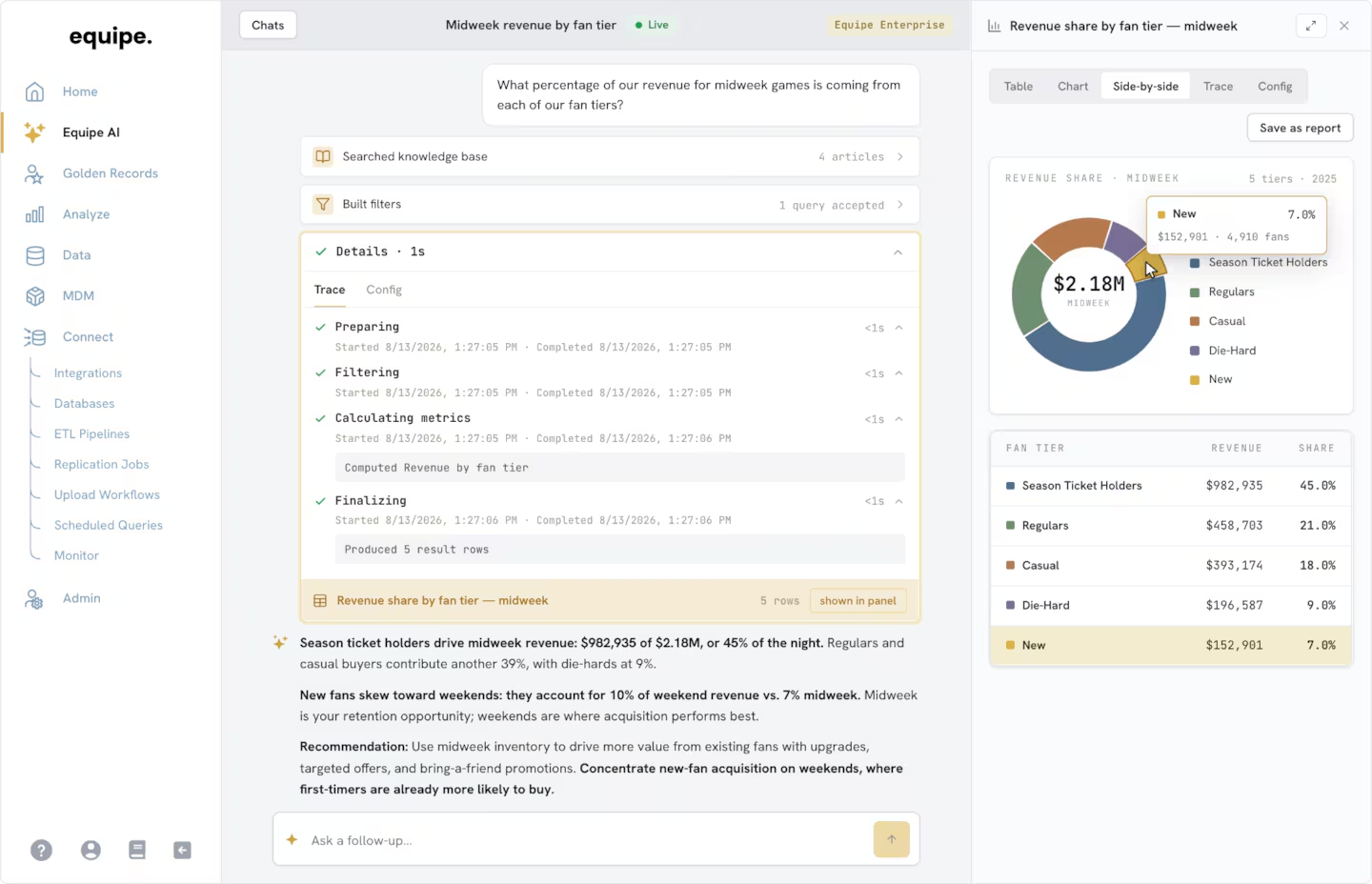
You can also finally use AI the way it was supposed to be used. With a trustworthy foundation underneath, natural language queries return reliable answers. Recommendation engines make sense. Predictive models actually predict. The AI is only as smart as the data feeding it, and a golden record makes the data smart.
THE NEXT TWELVE MONTHS
The organizations that will win the next phase of college athletics revenue growth are not the ones buying the most AI tools. They are the ones building the data foundation that makes those tools work.
Bjork is right that athletic departments are sitting on a ton of data that has not been deployed strategically. Every program in the Power 4 is sitting on a similar pile. The same ticketing systems, the same donor platforms, the same marketing tools. What separates the programs that will break out from the ones that will stay stuck is what they do with that data in the next twelve months.
Master data management is not glamorous work. Golden records do not make for exciting press releases. But the departments that invest in this discipline now will look up in a year and find themselves with answers while their peers are still exporting CSVs.
That is the quiet edge. It is available to anyone willing to take the unified view of their fan seriously.