

THE REAL-TIME REVENUE GAP IS REAL
Every game, every event, every broadcast window creates moments that move the market. A career night from a star player. A walk-off in the bottom of the ninth. A viral highlight that hits social before the final whistle. The energy peaks in real time, fans want to participate in real time, and the revenue opportunity, ticket demand, merchandise pull, sponsorship value, donor sentiment, is sitting right there, in the moment.
Most sports organizations cannot act on it.
Not because the front office is asleep at the wheel. The opposite, actually. Revenue teams in collegiate athletics and pro sports are some of the most competitive, creative operators in the business. The problem is structural. The data that signals what is happening, ticket scans, concession spend, app sessions, broadcast minutes, social engagement, donor activity, sits in different systems with different identifiers on different refresh cadences. By the time anyone has a unified picture of what just happened and who was part of it, the window is closed.
So organizations respond the next day. They roll out the commemorative jersey, the themed ticket promo, the snack bar tie-in. Creative work, well-earned, well-received. But late. The activation that could have ridden the wave instead chases it.
This is the gap that everyone in sports technology is now trying to close. The question is how.
TWO PHILOSOPHIES FOR CLOSING THE GAP
There are essentially two schools of thought on solving this.
The first says the answer is a unified fan experience platform. A single, lone vendor owns the website, the mobile app, the personalization engine, the orchestration layer, and increasingly the data underneath all of it. The pitch is appealing on its surface. One platform, one roadmap, one vendor relationship. Replace the messy stack with a clean, integrated alternative.
The second school of thought says the gap is a data problem, not a platform problem. The tools in the stack are mostly fine. The ticketing system is good at ticketing. The donor CRM is good at donor management. The marketing automation tool is good at sending marketing emails. The app vendor knows how to build apps. What is missing is a layer underneath all of them that unifies the data they generate and makes it actionable in real time, without forcing the organization to standardize on any single vendor's view of the fan.
We are firmly in the second camp. Equipe was built on that premise.
Here is why.
REPLACING TEN SILOS WITH ONE IS NOT BREAKING DOWN SILOS
When a single vendor owns the fan experience layer end to end, the organization is renting capability instead of owning it. The audience logic, the segmentation rules, the propensity models, the integrations to ticketing and donor systems, all of it lives inside someone else's platform. The data is accessible only through the tools the vendor chooses to build, on the timeline the vendor chooses to ship.
That is consolidation, not unification. The walls are wider, but they are still walls.
For a Power 4 athletic department, that trade is particularly costly. Programs at this level already operate sophisticated, deeply embedded stacks. Paciolan or Ticketmaster for ticketing. Salesforce as the CRM of record for many departments. Eloqua for marketing automation across a significant share of programs. Donor systems woven into development workflows that predate the current revenue team. Streaming partnerships, merchandise platforms, in-venue tech, and app vendors that come bundled with conference deals or campus IT mandates.
A program cannot rip and replace all of that in the name of unification. And honestly, they should not want to. Those tools were chosen for reasons that still hold.
The problem has never been that the tools are bad. In fact, most are great for their specific purpose. It’s what drives their core value proposition. Steakhouses are great steaks.
The problem is that the data they generate sits trapped inside each of them.
THE CDP APPROACH, PURPOSE-BUILT FOR SPORTS
A customer data platform sits underneath the rest of the stack rather than on top of it. It pulls data out of ticketing, donor CRM, marketing automation, streaming, merchandise, app analytics, and anywhere else fan signal lives. It resolves identities across those sources into a single golden record. It makes that record accessible to every system and every person who needs it.
The activation layer, audience building, next-best-action prompts, propensity scoring, segmentation, sits on top of the unified data, not in place of the rest of the stack. And the data and the logic stay with the organization.
If a program swaps its app vendor next year, the CDP keeps running. If it brings on a new streaming partner, the CDP ingests the new source. If the marketing team wants to test a new email platform, the audiences they built do not get stranded. Best-in-class tools stay in play, and the organization gains the unified, actionable view it has been missing and actually owns the data underneath.
That is what we built Equipe to do, specifically for collegiate athletics.
WHAT OWNERSHIP AND FLEXIBILITY ACTUALLY LOOK LIKE
When we talk about ownership, we mean three concrete things.
THE DATA IS YOURS
The golden record, the identity resolution logic, the custom fields, the historical data, all of it lives in single-tenant infrastructure that belongs to you. Not in a shared vendor instance. Not behind an API the vendor controls. Yours, in a system the program can audit, extend, and take with them.
THE LOGIC IS YOURS
How accounts get created, how households get resolved, how donors and ticket buyers and app users get matched, all of that is configurable by the program and visible to you. We deliver capabilities in a transparent box, not answers in a black box. The program controls the rules that define its fan.
THE STACK IS YOURS TO ASSEMBLE
The point of a CDP is that the rest of the stack stays flexible. You can use the ticketing system that fits its business, the CRM the development office prefers, the marketing automation tool the marketing team knows, the app vendor that delivers the best in-venue experience. The CDP unifies the data underneath all of it and pushes activation back out to wherever the team is already working.
This is the part that often gets lost in the unified-platform pitch. Best-in-class is not a buzzword. It is a strategy. The marketing tool that wins on email is rarely the same vendor that wins on in-venue app experience, which is rarely the same vendor that wins on donor management. Forcing a program to use one vendor's version of all of those is a trade that costs more than it saves.
REAL-TIME IS A DATA PROBLEM, NOT A PLATFORM PROBLEM
Come back to the moment that matters. The career night, the walk-off, the viral highlight. The reason most organizations cannot activate in the moment is not that they lack a unified fan experience platform. It is that the signal that something is happening is sitting in different systems with different identifiers, on different refresh cadences, with no way to resolve it to a known fan in time to act.
Solving that does not require ripping out the app, the website, or the ticketing system. It requires a data layer that can ingest those signals in real time, resolve them to known fans, and push activation back out to the channels the organization already runs.
That is a CDP job. And it is the job we built Equipe to do for college athletics specifically, because the data structures, the revenue streams, and the organizational realities of a Power 4 program are different enough from pro sports or general enterprise that a generic CDP does not cut it.
WHAT THIS LOOKS LIKE FOR FRONTLINE REVENUE STAFF
The other half of this is who actually gets to use the data once it is unified.
In the walled-garden model, the activation happens inside the vendor's experience layer, which means the people closest to revenue, ticket AEs, fundraisers, marketers, suite sales, are often a step removed. They submit requests. They wait on lists. They get reports on a delay. Maybe they get access, but it’s priced on seats
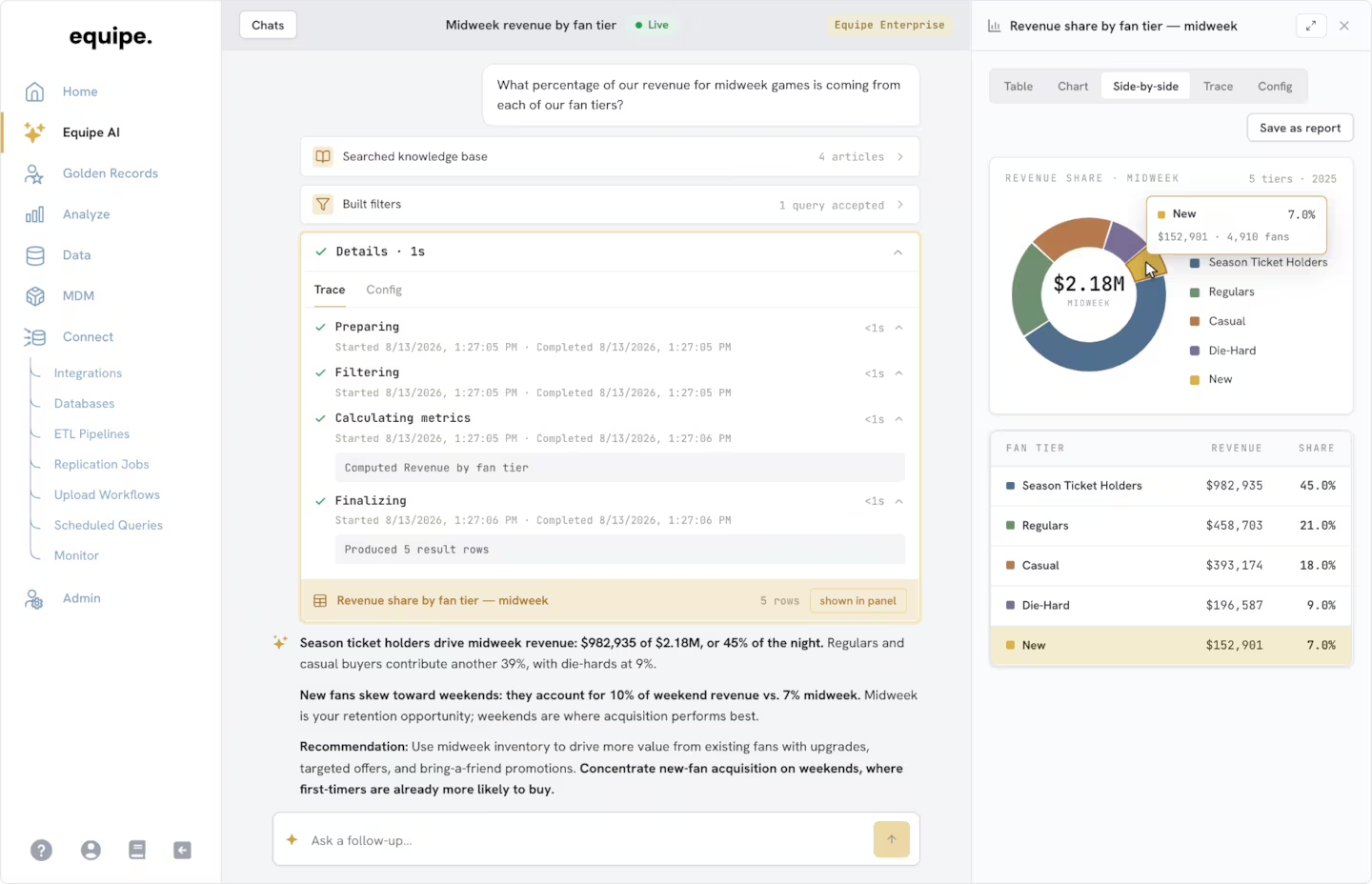
The CDP model puts activation in their hands directly. A ticket AE filters for season ticket holders who attended a specific game, who have purchased single-game tickets in the last 90 days, who live within 30 miles, and who have not yet been contacted about an upcoming matchup. The audience builds in seconds. The export goes to whatever outreach tool the team is already using. The play runs the same day. At Equipe, we specifically give unlimited seat access for that reason, to lower the barrier to running those plays everyday as much as possible.
That workflow is repeatable across every sport, every revenue stream, every campaign. And it does not require the program to standardize on a single vendor for the channels those audiences ultimately get activated in.
THE BET WE ARE MAKING
The next era of sports revenue will be powered by systems that can think, adapt, and execute in real time. That part is not in dispute. The question is who owns those systems and how flexible they are.
We believe sophisticated programs deserve sophisticated infrastructure. They deserve a data layer they own, populated by the best-in-class tools they already use, accessible to every revenue team member who needs it, and built specifically for the way college athletics actually operates.
Breaking down silos does not mean replacing them with a single silo. It means building a foundation underneath them that the organization owns.
That is the future we are building for. And it is already live at programs like the University of Texas, the University of South Carolina, and the University of Iowa.